
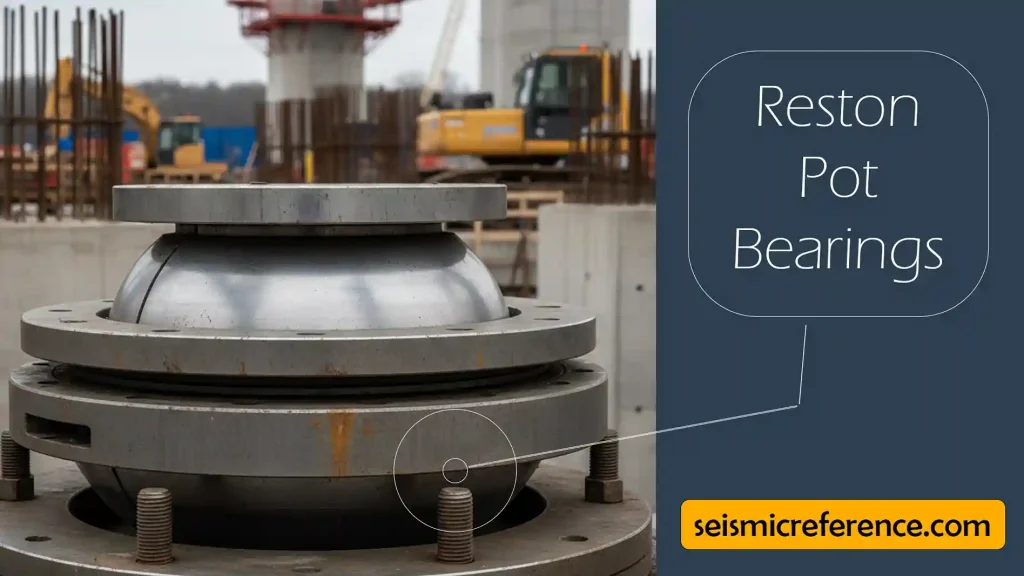
Understanding Reston Pot Bearings
Reston Pot Bearings are specialized structural components widely used in bridges, buildings, and infrastructure to manage heavy loads while allowing controlled movements and rotations. Research suggests they offer reliable performance in demanding environments, with features like low-friction sliding and durable sealing that enhance longevity. It seems likely that their adaptability makes them a preferred choice for engineers dealing with frequent deformations, though proper installation is crucial to avoid issues like misalignment.
What Are They?
These bearings, often from manufacturers like Mageba, consist of a steel pot enclosing an elastomeric pad that acts like a fluid under pressure, enabling smooth rotations and load transfer.
Main Benefits
- Handle vertical loads up to 75 MN or more in high-performance versions.
- Accommodate movements in specific directions, reducing stress on structures.
- Compliant with standards like EN 1337-5, ensuring safety and quality.
Potential Drawbacks and Considerations
While effective, they require regular maintenance for optimal function, and costs can vary based on customization. Always consult experts for site-specific needs.
For more details, check resources from Mageba or bridge engineering guides.
Reston Pot Bearings represent a cornerstone in modern structural engineering, providing essential support in scenarios where buildings and bridges must endure significant stresses without compromising integrity. These devices, exemplified by Mageba’s RESTON®POT series, facilitate the seamless transfer of vertical and horizontal forces while permitting necessary rotations and displacements. Engineers often turn to Reston Pot Bearings for their robustness in high-load environments, such as viaducts and industrial facilities, where traditional supports might falter under repeated movements.
The Fundamentals of Reston Pot Bearings
Reston Pot Bearings operate on a simple yet ingenious principle: a confined elastomeric pad within a steel enclosure behaves hydraulically under compression, distributing loads evenly and allowing multi-axis rotations. This design minimizes wear and extends service life, making Reston Pot Bearings ideal for dynamic structures.
Types Available
Fixed (TF) variants lock horizontal movements entirely, offering stability where lateral forces must be fully resisted. Guided sliding (TE) types allow unidirectional shifts, perfect for elongated bridges. Free sliding (TA) options permit omnidirectional horizontal motion, transmitting no external forces.
Applications in Infrastructure
From the Glattalbahn Viaduct in Switzerland to the Vasco da Gama Bridge in Portugal, Reston Pot Bearings have proven their mettle in real-world projects. They excel in concrete and steel constructions, accommodating longitudinal and transverse deformations that arise from thermal expansions or seismic activity.
Bridge Construction
In bridge design, Reston Pot Bearings support superstructures by isolating them from substructures, reducing vibration transmission and enhancing overall durability.
Building and Industrial Use
For high-rise buildings or conference centers, like those in Hong Kong, these bearings manage loads from wind or occupancy, ensuring structural flexibility without sacrificing strength.
Key Features and Innovations
What sets Reston Pot Bearings apart is their integration of advanced materials and engineering. A POM sealing chain, vulcanized into the elastomeric pad, provides superior wear resistance compared to outdated brass seals, preventing common failures.
Sliding Mechanisms
Polished austenitic stainless steel paired with PTFE surfaces, complete with grease dimples, achieves low frictional resistance. This setup ensures smooth operation even under extreme conditions down to -31°F.
Protective Elements
Removable rubber aprons or folding sheet covers shield internal components from dust, facilitating easy inspections and maintenance.
Materials and Construction Quality
Crafted from grade S355 steel, natural rubber pads, and certified PTFE, Reston Pot Bearings prioritize longevity. Silicone grease lubricants maintain performance in harsh climates, while corrosion protections are customized to environmental demands.
Durability Standards
Adhering to EN 1337-5 and AASHTO guidelines, these bearings undergo rigorous type testing. CE marking and AISC certifications underscore their reliability.
Technical Specifications
Reston Pot Bearings come in standard sizes with vertical load capacities ranging from 1 MN to 75 MN, though high-performance (HP) versions push this to 90 MN with halved dimensions due to doubled rubber strength (120 N/mm²). Horizontal loads can reach 40 MN in robust setups.
| Load Type | Capacity Range | Rotation Capability | Displacement Allowance |
|---|---|---|---|
| Vertical | 1-90 MN | Up to 0.02 rad | N/A (fixed types) |
| Horizontal | Up to 40 MN | N/A | ±50-100 mm (sliding types) |
| Combined | Variable per design | 0.01-0.03 rad | Customizable |
These specs allow for tailored solutions, with optional 3-point leveling for precise installation.
Customization Options
Add-ons like movement scales or electronic monitoring (via RESTON®POT LIFT-CONTROL) enable real-time load measurement, aiding predictive maintenance.
Installation Best Practices
Proper setup is vital for Reston Pot Bearings to perform optimally. Factory pre-assembly includes adjustable pre-settings based on engineer-provided data, but on-site fine-tuning by specialists ensures alignment.
Step-by-Step Process
Begin with positioning using axis-marking grooves, then apply a thin mortar bed beneath. Secure via anchor dowels or plates, removing transport fittings only after full connection to avoid unintended shifts.
Replacement Considerations
Mixed anchoring simplifies future swaps, minimizing downtime in operational structures.
Maintenance and Longevity
With over 50,000 installations globally spanning five decades, Reston Pot Bearings boast impressive track records. Regular lubrication checks and protective cover inspections prevent degradation.
Inspection Protocols
Visual assessments of sliding surfaces and seals, coupled with movement indicator readings, help detect issues early. In uplift-prone areas, variants like RESTON®POT UPLIFT incorporate tensile restraints.
Benefits Over Alternatives
Compared to spherical or elastomeric pads alone, Reston Pot Bearings offer superior load-handling in confined spaces. Their low-profile design suits skewed or curved bridges, where space is premium.
Cost-Effectiveness
Initial investments pay off through reduced maintenance needs and extended lifespans, often outlasting project warranties.
Environmental Adaptability
Engineered for cold regions or seismic zones, they integrate with incremental launch methods (RESTON®ILM) for efficient construction.
Comparing Reston Pot Bearings to Other Systems
While pot bearings generally outperform plain elastomeric types in rotation capacity, Reston Pot Bearings edge out competitors with their POM sealing and certified materials.
| Feature | Reston Pot Bearings | Standard Pot Bearings | Spherical Bearings |
|---|---|---|---|
| Load Capacity | High (up to 90 MN) | Medium-High | Very High |
| Rotation | Multi-axis | Limited | Excellent |
| Space Requirement | Compact | Compact | Larger |
| Friction | Low (PTFE) | Variable | Low |
| Cost | Moderate | Low | High |
This table highlights why Reston Pot Bearings strike a balance for many projects.
Industry Feedback
Engineers praise their versatility, noting fewer failures in high-traffic bridges compared to older designs.
Selecting the Right Reston Pot Bearings
To choose appropriately, provide details on ultimate limit state loads, expected displacements, and rotations. Mageba’s technical teams offer custom quotes and data sheets.
Project-Specific Advice
For seismic areas, opt for guided types; in cold climates, ensure grease suitability.
Future Trends in Bearing Technology
As infrastructure demands evolve, innovations like integrated sensors in Reston Pot Bearings point toward smarter, IoT-enabled monitoring. Sustainability drives the use of recyclable materials, aligning with green building standards.
Research and Development
Ongoing studies focus on enhancing rubber formulations for even higher pressures, potentially revolutionizing mega-structures.
In summary, Reston Pot Bearings embody engineering excellence, blending tradition with cutting-edge features to support tomorrow’s infrastructure. Whether for a modest viaduct or a landmark bridge, their role in ensuring safety and efficiency cannot be overstated. With careful selection and upkeep, these bearings deliver unmatched value, safeguarding investments for generations.